As EV adoption continues to grow, one question is becoming increasingly important:
Where will people actually charge their vehicles?
While highways and dedicated charging stations play a role, the real transformation is happening in everyday urban locations—particularly shopping malls and hotels.
These spaces are quietly becoming some of the most important nodes in the EV charging ecosystem.
Charging Fits Naturally Into Consumer Behavior
Unlike traditional refueling, EV charging takes time.
This changes everything.
Drivers are no longer looking for places to “stop and leave”—they are looking for places where charging can happen while they do something else.
Shopping malls and hotels perfectly match this behavior:
- People already spend time there
- Parking durations are longer
- Charging becomes a background activity
In this sense, charging is not a separate action—it is integrated into daily life.
Malls: Turning Parking Time Into Value
Shopping malls are uniquely positioned to benefit from EV charging.
They already attract high traffic, and adding charging infrastructure can:
- Increase dwell time
- Improve customer experience
- Attract EV-driving consumers
- Enhance property value
For mall operators, charging is not just a service—it is a way to strengthen their ecosystem.
A parking space becomes more than just a parking space. It becomes an energy service point.
Hotels: Meeting a Growing Expectation
For hotels, EV charging is quickly shifting from a “nice-to-have” to a “must-have”.
Travelers with EVs increasingly expect:
- Convenient overnight charging
- Easy access within the property
- Reliable availability
Hotels that provide charging gain a competitive advantage, especially in urban and tourist-heavy areas.
In many cases, the ability to charge can directly influence booking decisions.
Semi-Public Charging Is the Missing Layer
Home charging is not always available—especially in dense urban environments.
Public fast-charging networks are expanding, but they cannot cover every scenario.
This is where semi-public locations like malls and hotels come in.
They fill the gap between:
- Private charging (home)
- Public charging (highways, stations)
This middle layer is essential for building a complete charging ecosystem.
A New Type of Infrastructure Node
Malls and hotels are no longer just commercial spaces.
They are becoming part of a broader urban infrastructure network.
By integrating charging, they connect:
- Mobility
- Energy
- Consumer behavior
Over time, these locations may evolve into multi-functional hubs—combining retail, services, and energy distribution.
The Shift Has Already Begun
Across major cities worldwide, this transformation is already visible.
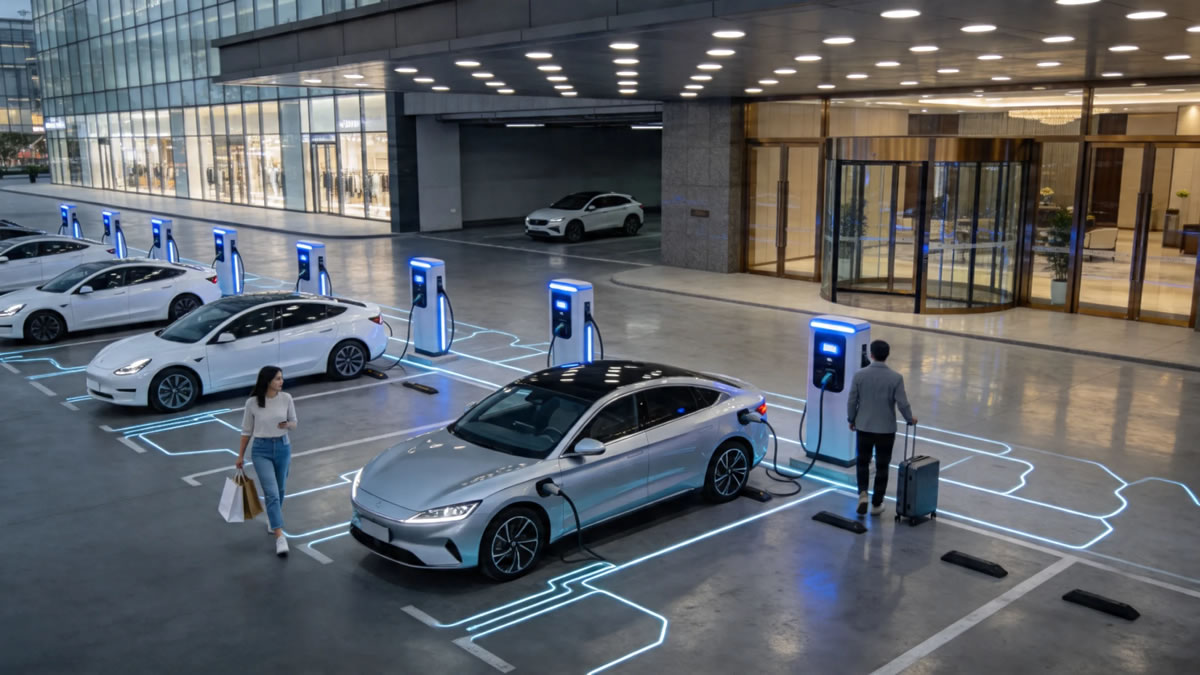
Charging stations are appearing in parking garages, hotel entrances, and commercial complexes.
What was once an added feature is quickly becoming an expected standard.
The Bigger Picture
The rise of EV charging is not just about building more stations.
It is about embedding energy access into the places people already go.
Shopping malls and hotels are leading this shift—not because they are energy companies, but because they understand user behavior.
And in the future of EV charging,
the most valuable locations will be where people already spend their time.
 April 16, 2026