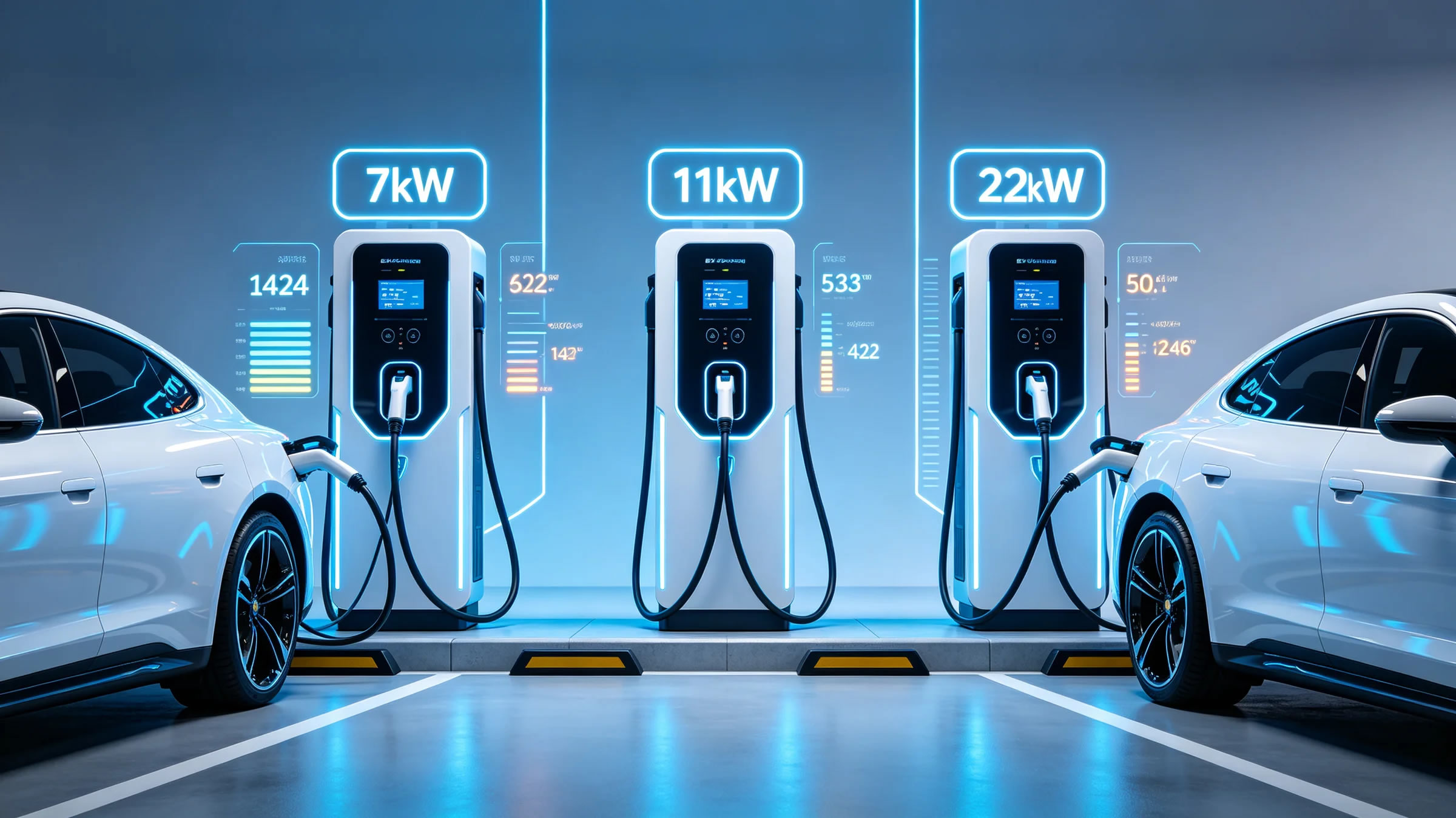
When choosing a home EV charger, one of the most common questions is: Should I choose 7kW, 11kW, or 22kW? While higher power may seem like the better option, the reality is more nuanced. Charging performance depends not only on the charger itself, but also on your vehicle, electrical system, and daily usage.
This guide compares these three common power levels and helps you make a practical, well-informed decision.
1. Understanding What Charging Power Means
Charging power, measured in kilowatts (kW), determines how quickly energy can be delivered to your vehicle.
In general:
- Higher kW = faster charging
- But only if your vehicle supports that power level
A key point to remember:
Your vehicle’s onboard charger sets the maximum AC charging speed
This means a 22kW charger will not charge faster if your vehicle only supports 7kW or 11kW.
2. 7kW EV Chargers
Overview
7kW chargers are the most widely used option for residential charging.
Charging Speed
- Around 30–50 km of range per hour
- Fully charges most vehicles overnight
Best For
- Daily commuting
- Overnight charging
- Homes with single-phase electricity
Advantages
- Lower cost
- Easy installation
- Compatible with most EVs
Limitations
- Slower than higher-power options
3. 11kW EV Chargers
Overview
11kW chargers provide a noticeable increase in charging speed.
Charging Speed
- Around 50–80 km of range per hour
Best For
- Drivers with higher daily mileage
- Homes with three-phase electricity
Advantages
- Faster charging
- More future-proof
- Better for larger battery EVs
Limitations
- Requires three-phase power
- Higher installation cost
4. 22kW EV Chargers
Overview
22kW chargers offer the highest AC charging power available for most applications.
Charging Speed
- Up to 100 km of range per hour (vehicle dependent)
Best For
- Commercial or semi-public use
- Users with compatible high-power vehicles
- Future-ready installations
Advantages
- Maximum AC charging speed
- Suitable for multiple users or high demand
Limitations
- Not all vehicles support 22kW AC charging
- Higher cost and electrical requirements
5. Key Differences at a Glance
| Feature | 7kW | 11kW | 22kW |
|---|---|---|---|
| Speed | Moderate | Fast | Very fast |
| Power Supply | Single-phase | Three-phase | Three-phase |
| Installation Cost | Low | Medium | High |
| Typical Use | Home | Advanced home | Commercial / future-ready |
| Vehicle Compatibility | High | Medium | Limited |
6. How to Choose the Right Option
Instead of choosing the highest power available, consider these factors:
1. Your Vehicle
- Check maximum AC charging capacity
- Avoid overpaying for unused power
2. Your Daily Driving Needs
- Short daily trips → 7kW is sufficient
- High usage → consider 11kW
3. Your Home Electrical System
- Single-phase → typically 7kW
- Three-phase → 11kW or 22kW possible
4. Future Plans
- Planning to upgrade your EV?
- Considering multiple vehicles?
7. Practical Recommendation
For most users:
- 7kW → Best balance of cost and practicality
- 11kW → Good upgrade for faster charging
- 22kW → Suitable for specific or future-focused needs
There is no one-size-fits-all solution—the right choice depends on your individual situation.
Choosing between 7kW, 11kW, and 22kW EV chargers is not simply about selecting the most powerful option. It is about matching the charger to your vehicle, your home, and your daily routine.
A well-matched charging solution provides reliable performance, reasonable cost, and long-term convenience. As EV technology continues to evolve, understanding these fundamentals will help you make smarter and more confident decisions.
 August 10, 2026