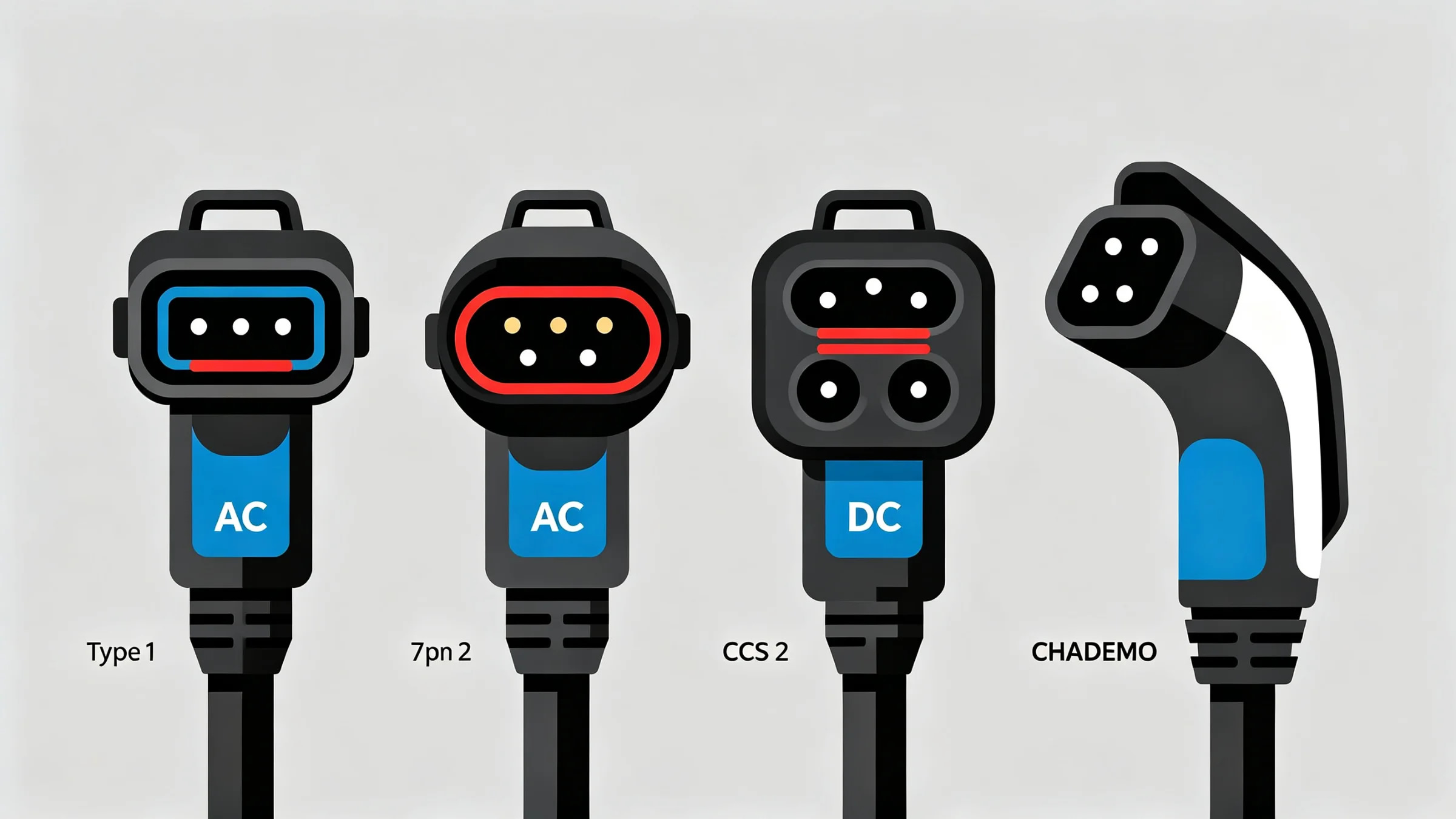
One of the first things EV owners need to understand is charging connector compatibility. Different electric vehicles use different connector designs, and the correct connector depends on the vehicle model, region, and type of charging required.
Terms such as Type 1, Type 2, CCS, and CHAdeMO can be confusing, especially for new EV owners. While some connectors are mainly used for AC charging, others are designed for high-power DC fast charging.
This guide explains the main EV charging connector types and what drivers should check before choosing a charging solution.
1. What Is an EV Charging Connector?
An EV charging connector is the physical connection between the charging equipment and the vehicle.
It allows electricity to be delivered safely while enabling communication between the charger and the vehicle.
Connector compatibility can depend on:
- Vehicle model
- Country or regional market
- AC or DC charging
- Vehicle charging system
- Charging power
For this reason, checking the charging port on your vehicle is one of the most important steps before purchasing a charger.
2. Type 1 Connector
The Type 1 connector, also known as the SAE J1772 connector, is mainly used for AC charging.
It has been widely used in North America and on some vehicles sold in other markets.
Key Features
- Primarily used for AC charging
- Commonly associated with single-phase charging
- Supports communication between the vehicle and charger
- Used by various older and regional EV models
Type 1 compatibility depends on the vehicle and market. Drivers should always check their vehicle's charging port and manufacturer specifications.
3. Type 2 Connector
The Type 2 connector, sometimes called the Mennekes connector, is widely used in Europe and many international markets for AC charging.
Compared with Type 1, Type 2 can support both single-phase and three-phase AC charging, depending on the vehicle and electrical system.
Key Features
- Used primarily for AC charging
- Supports single-phase and three-phase power
- Can support higher AC charging power
- Widely used in European EV markets
Type 2 has become an important connector format for home, workplace, and public AC charging.
4. CCS: Combined Charging System
CCS, or Combined Charging System, combines AC charging connections with additional DC power contacts for fast charging.
There are two common versions:
CCS1
CCS1 is based on the Type 1 connector design and is primarily used in North America and other selected markets.
CCS2
CCS2 is based on the Type 2 connector design and is widely used in Europe and many other markets.
The key advantage of CCS is that the vehicle can use the same charging port design for both regular AC charging and high-power DC fast charging.
Key Features
- Supports AC and DC charging
- Designed for fast charging applications
- Widely used by many modern EV manufacturers
- Different regional versions include CCS1 and CCS2
The maximum charging power depends on the vehicle, charging station, battery condition, and other technical factors.
5. CHAdeMO Connector
CHAdeMO is a DC fast-charging connector standard that was widely used by Japanese EV manufacturers.
Unlike CCS, CHAdeMO uses a separate connector specifically designed for DC charging.
Key Features
- Designed for DC fast charging
- Separate connector from the AC charging port in many vehicles
- Historically common on several Japanese EV models
- Still available in some markets and charging networks
Its use varies by region and vehicle generation. When selecting charging equipment, EV owners should check the connector type used by their specific vehicle.
6. Connector Type vs Charging Standard
It is important to understand that a charging connector and a charging standard are related but not exactly the same thing.
The connector is the physical plug and socket connection between the vehicle and charger.
The charging system also includes communication protocols, electrical requirements, and safety functions that allow the vehicle and charging equipment to operate together.
In simple terms:
Connector = How the vehicle physically connects
Charging standard = How the charging system exchanges power and communicates
This is one reason why two chargers with similar-looking connectors may still have different technical requirements.
7. How to Choose the Right Connector
Before purchasing an EV charger, follow these steps:
Step 1: Check Your Vehicle
Identify the charging port installed on your EV.
Step 2: Check AC and DC Compatibility
Determine whether you need:
- AC charging for home or regular daily charging
- DC fast charging for rapid charging
Step 3: Check Maximum Charging Power
Your vehicle determines the maximum power it can accept.
A higher-power charger will not necessarily charge your vehicle faster if the vehicle has a lower charging limit.
Step 4: Check Your Local Market
Connector availability can vary by country and region.
Before choosing equipment, confirm which connector types are commonly supported by your vehicle and local charging infrastructure.
8. Quick Comparison
| Connector | Main Charging Type | Typical Application |
|---|---|---|
| Type 1 | AC | Home and regular AC charging |
| Type 2 | AC | Home, workplace, and public charging |
| CCS1 | AC + DC | Regular and fast charging |
| CCS2 | AC + DC | Regular and fast charging |
| CHAdeMO | DC | DC fast charging |
Actual compatibility and charging power always depend on the specific vehicle and charger.
Understanding EV charging connectors can make choosing and using charging equipment much easier. Type 1 and Type 2 are commonly associated with AC charging, while CCS and CHAdeMO are used for DC fast-charging applications.
However, there is no single connector that is suitable for every vehicle or market. The best approach is to first check your vehicle's charging port, understand its maximum charging capability, and consider the connector standards used in your region.
Before purchasing a charger, remember the basic rule:
Check the vehicle first, then choose the connector, charging type, and power level.
With the right charging equipment and compatible connector, EV charging can be safer, more convenient, and better suited to everyday driving needs.
 August 24, 2026